
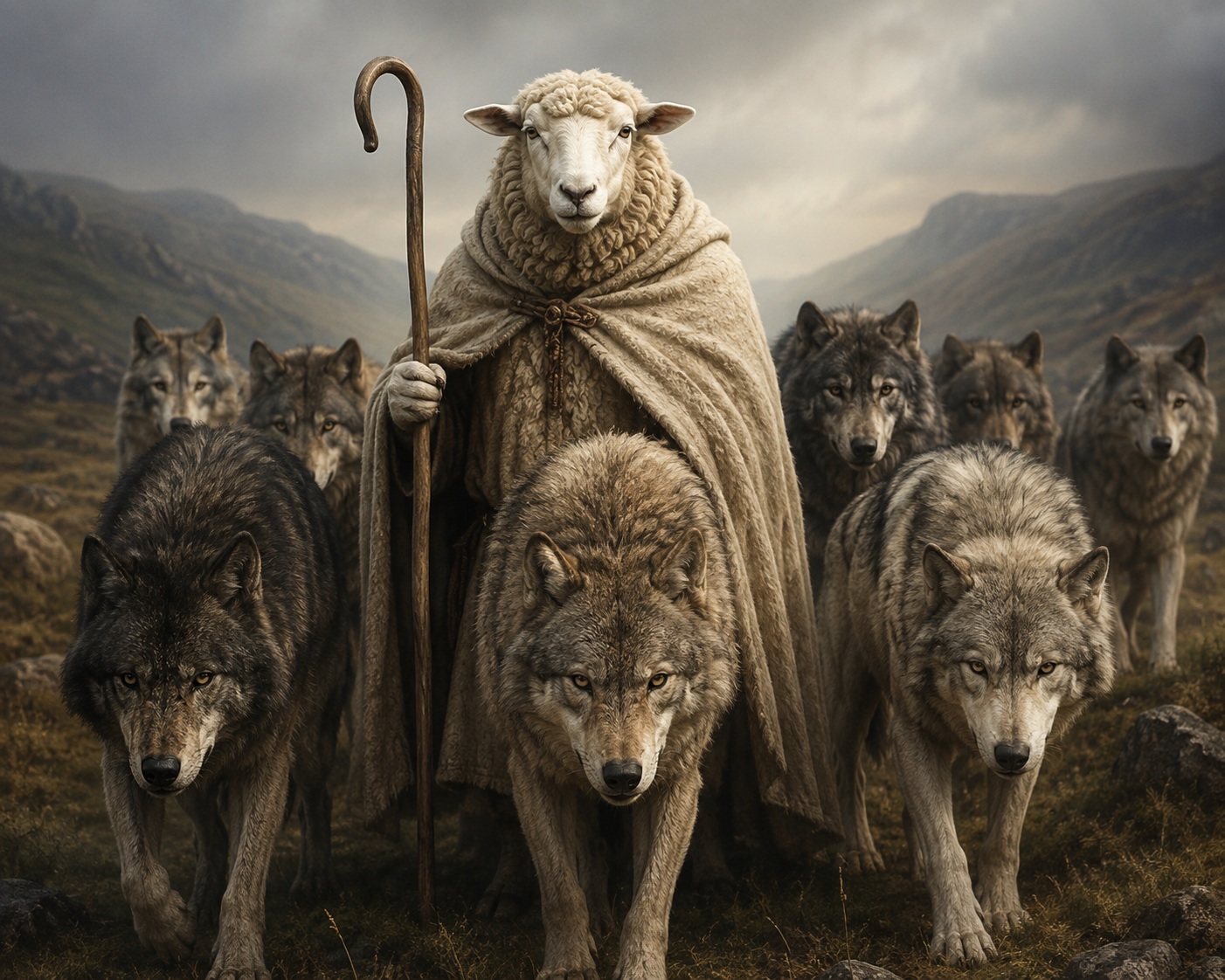
Behold, I send you forth as sheep in the midst of wolves: be ye therefore wise as serpents, and harmless as doves.
Matthew 10:16
1. The Paradox of a Father’s Love
By logical assessment, this is one of those most ‘unfatherly’ verses of the Bible. Why would I say so? Every good father sends their child out with caution, never letting them take the path of danger. Sometimes, fathers set physical, visible boundaries, to keep the child within the fringes of safety. God is a better Father, our Heavenly Father, so He should know better. Unfortunately, here, He says, “I am sending you on an errand to your natural enemies, who look out for opportunities to prey on you.” The Good News Translation conveys that sense more bluntly: “I am sending you out just like sheep to a pack of wolves.”
If God only said, “Behold, I send you forth,” that would have been acceptable. Even if He had said, “Behold, I send you forth as sheep,” that would still have been ok. But to know that I am a sheep, a mere sheep, then send me “to a pack of wolves,” many “wolves,” that does not seem fair at all. If I would deal with just one wolf, that might still have been excusable, but “wolves” … as if to say, “When you shall have escaped the first wolf, you will still have more wolves to deal with. So, watch out: one wolf overcome will not be all dangers defeated.” That is tough to handle, coming from a Father.
2. Did God Send Me? – Questions in the Eye of the Storm
If my mission takes me among wolves, would it be the loving God sending me into (or through) such apparent danger? According to Psalm 23, when the Lord, the Good Shepherd, leads, one encounters “green pastures” and “still waters.” Unfortunately, here is a verse that seems to say otherwise: wolves. Shouldn’t the loving Father have sent me out as a lion to wolves? Why not send sheep to other sheep, and wolves to wolves? Do wolves need a sheep to transform them from their predatory nature?
Even though the language is evidently symbolic; even though we understand that the Master was not speaking about actual sheep being sent into the midst of actual wolves, the simile is clear: Your mission will take you through paths of danger, fear, and threats. Then I ask, What’s the point in the Father passing tender sheep through such emotional trauma?
Sometimes, we find ourselves in places that appear to question the love of God for us. Sometimes, obedience to God brings us face to face with danger that a different choice would have spared us. Then we question our commission that seems to differ from the blissful Psalm 23 encounters of other ‘privileged’ folks, and we worry, “Was it God that sent me, or did I send myself?” It will appear, from our text, that apparent safety and comfort are not the standard measures of divine commission. Even Psalm 23 is not all about blissful pastures and quiet waters. That is where it starts – “green pastures,” but the journey goes through a phase called “the valley of the shadow of death,” before the restorative phase of overflowing cups and accompanying goodness and mercy in the house of the Lord.
3. Survival Kits and the Patterns of God
God does not only send, He also equips. He did not only send the sheep in “the midst of wolves,” He also gave the kits for survival in those circumstances: “wise as serpents, and harmless as doves.” To win, you do not always need strength to match strength. What you might need could be just strategy. You do not have to become a beast to overcome beasts. The strength for confronting and overcoming wolves, according to the Master, is wisdom; wisdom to know how to respond, how to interact, how to navigate life in those circumstances. Wisdom is strength.
In God’s great wisdom, it takes sheep to win wolves. You don’t win wolves by being like them: carnivorous, predatory, bloody, devouring, ferocious. Humans have become friends of dogs not by barking like them, but by loving them. I saw a video of a tamed large crocodile interacting with its master in the pool. How did the man get there with that beast? Apostle Peter shares similar wisdom in 1 Peter 5:8 where he says that how to overcome the devil when he manifests as a roaming, roaring lion is not to roar back at him, but to be sober and vigilant. When the same devil manifests as an accuser, however, he is overcome by the blood of the Lamb and by the word of testimony (Revelation 12:11). You did not have to use Satan’s weapons to fight him, matching accusation for accusation. You can never beat the devil at his own evil game.
4. Lessons from the Unlikely – the Balance in Life
Venomous as the serpent is, there is a lesson to learn from it: wisdom. Weak as the dove might seem, it teaches an eternal lesson: the power of peace and harmlessness. One balances the other. That’s the unique balance in life: the wisdom of the serpent and the meekness of the dove. Jesus is both Lion and Lamb. All lamb without lion makes you a prey; all lion without lamb makes you a beast. Jesus is both the Lion of the Tribe of Judah (Revelation 5:5) and the Lamb of God (John 1:21). Wisdom without meekness makes one a serpent; meekness without wisdom makes one a bird of prey. Get the wisdom of the serpent but not his venom; match that wisdom with the meekness of the dove.
5. The Lion and the Lamb
The cunningness of the serpent without the harmlessness of the dove is as dangerous as the harmlessness of the dove without the wisdom of the serpent is unsafe. It takes the strategic combination of the two to survive the company of wolves, in the ministry to wolves. Revelation 17:14 reports the foolishness of some who take the apparent lowliness of the Lamb for granted and go out to “war with the Lamb.” To their eternal regret, they were to find a fighter in the apparently meek Lamb: “the Lamb shall overcome them.”
Revelation 6:16 speaks further of “the wrath of the Lamb.” Can a lamb be wrathful; wrathful to the point of inflicting such triumph and terror upon the enemies that they begin to beseech mountains and rocks to crush them, if only to hide them from “the face” of the Lamb on His throne? So, never take lambs for granted. They can go to war, and you might be unable to stand them, and they could sit as king to watch you burn, “tormented with fire and brimstone” – with the “holy angels” as audience and witnesses of your foolishness and woes (Revelation 14:10).
6. Check you Tools
Being sent is one thing; using the appropriate tools for that mission is something else. A sent person among wolves could become prey if they rely on their divine commission alone without the tools for that specific commission. Sheep can become prey to wolves on a mission of God if they should fail to apply the cautions of God.
Does God ever send tender sheep into the midst of dangerous wolves? Is it God or Satan or self that commissions the sheep we may find in the midst of unfriendly packs? Is it love for the wolves or dislike for the sheep when the Father sends one of His weak ones into such danger zones?
Once upon a time, Goliath the giant of the Philistines, in great contempt for the people of God, cried out, “I defy the armies of Israel this day; give me a man, that we may fight together” (1 Samuel 1:10). After forty days, God had had enough of that uncircumcised Philistine’s bluff. God didn’t send him a man. God sent him a boy – David. To add salt to injury, as they say, that boy was not even carrying a sword. He was armed with a sling and a stone, as if he had come out to hunt a lizard. You know the rest of the story: “David prevailed over the Philistine with a sling and with a stone” (1 Samuel 17:50). The women could not hold it. They broke out in spontaneous praise (1 Samuel 18:6-7). Why would God send a boy against a giant man, or send sheep into the midst of ferocious wolves? To destroy those He thus sends?
Paul has the answer for us in the first chapter of his first letter to the Corinthians: our calling is unique. God would usually ordain the apparently foolish to deal with the wise. When He is out to “confound” those who consider themselves “mighty,” He doesn’t send out mighty folks. According to His patterns, He sends out “the weak things of the world” to deal with those, and “base things,” which are “despised,” to disgrace the noble. He does it that way so that “no flesh should glory in his presence” (1 Corinthians 1:26-29).
That must have been the assurance that emboldened the Psalmist to exclaim, “Yea, though I walk through the valley of the shadow of death, I will fear no evil.” Why? “for thou art with me.” He was assured that, beyond that valley of ferocious wolves, the Good Shepherd would prepare for him a welcoming table “in the presence of mine enemies,” then proceed to anoint him with the overflowing oil, compelling “goodness and mercy” to follow him every day of his life, bringing him ultimately to rest “in the house of the LORD for ever” (Psalm 23:4-6).
Jesus was not full of the devil but “full of the Holy Ghost” when He found Himself in the wilderness, led thither not by an act of His backsliding or by the devil but “by the Spirit.” Of Him, it was later said, “And Jesus returned in the power of the Spirit into Galilee” (Luke 4:1, 14). He “returned” fuller, stronger, better. Whom the Spirit leads there does not expire there. He shall return fuller and better; he “shall doubtless come again with rejoicing, bringing his sheaves with him” (Psalm 126:6). Amen.
From The Preacher’s diary,
August 10, 2026.



So blessed by the article, Sir. This gives more perspective to our travails as sent children of God. Thank you for sharing Sir
To emerge victorious when the odds are obviously against one is proof of the Hand of God at work. God is consistent in.making the seeming advantage of the devil shortlived.
The Preacher’s Pen has never ceased to make me take a second look at familiar scriptures. More grace, sir.
Quite an insightful message…
What a word. Where Christians are quick to say the kingdom of God surfers violence and the violent takes it by force. It’s important for us to be reminded that everything is not about force in the kingdom. Some have expired because they used the wrong tools. May God grant is wisdom, revelation and understanding to use the right tools for every assignment and give us victory in Jesus name amen