
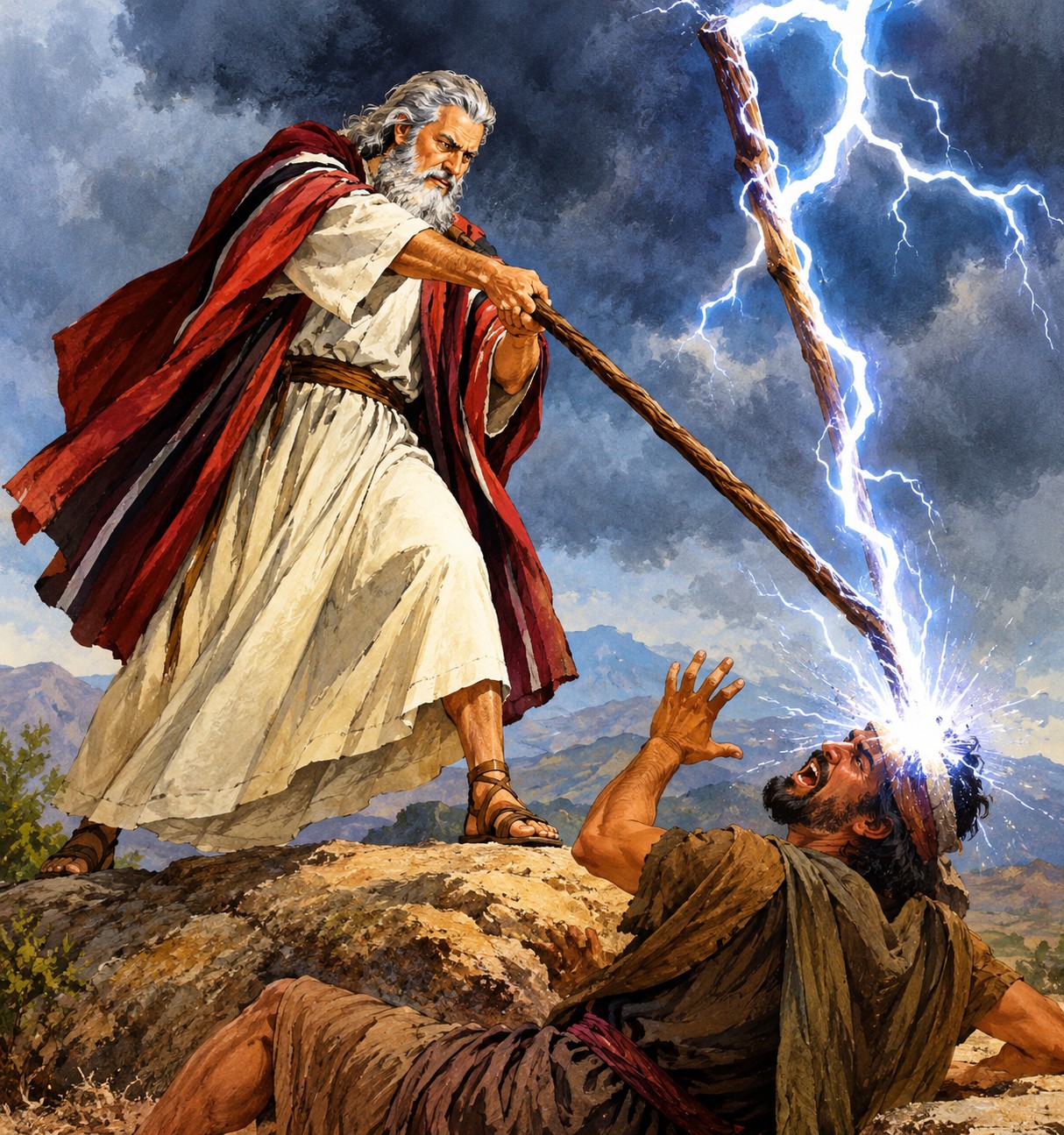
WHY MOSES KILLED AARON (Part 1 of 2)
1. Moses the Fighter
According to Ancient History, Moses, raised as a prince in the courts of Pharaoh, was a general in the army of Egypt. Josephus, the famous Jewish historian of antiquity, is said to have also reported of him as a handsome and educated mighty warrior, who led his armies to reputable victories for Egypt. That was probably where he learnt his toughness and impatience with opponents. On his very first outing in the ghettos of the enslaved Jews, for instance, according to Bible records, he invited himself into a street fight and gave his opponent such a lightning super punch that that fighter was knocked out instantly into an early shallow grave (Exodus 2:11-12). There was hardly a ‘second round’ and little need for an ambulance in the fights of Moses. His opponents seldom lived to tell their story. He was a “mighty” man.
The second day after his popular ghetto knockout, Moses was out in the streets again, fishing for another fight, when he got wind that the Homicide Squad from the Egyptian Police was after him. He fled far into a desert country, with no time to pack a bag (Exodus 2:13-15). There, too, on his first day in exile, according to Bible accounts, he got involved in a public fight with some shepherds who had been oppressive to their female folks (Exodus 2:16-19). One man versus other men; one turbulent nobleman versus a couple of rough shepherd boys. His temper seemed to follow him everywhere, although those for whom he sometimes stood occasionally excused him as a defender of the oppressed, no matter the oppressor, no matter where and how.
At one time, again according to the Bible, God had asked this fighter-turned-preacher to command water from a rock for his mobbish congregation angling for a pint of his blood to quench their desert thirst. Then, too, his hasty hand had struck the rock with his rod, rather than speak to it, as instructed by his God (Numbers 20:8-13). He seemed quicker with his blows than with words, even when God was involved. Regrets followed only later.
2. A Family of Talkers
Moses was few with words, made so by the disciplines of his middle years, but whenever he chose to speak, he was calculated and persuasive. The New Testament section of the Holy Bible describes him not only as very “learned” but also as “mighty in words and in deeds” (Acts 7:22). We might wish to translate that as ‘eloquent and masculine,’ ‘brainy and brawny,’ ‘a talker and a taker’; a man of no empty words when he chose to speak. When Moses did not punch with his hands, his words were no less punchy, and it got him into trouble at times, as Bible records state (Psalm 106:33).
The gift of persuasive eloquence seemed to have been a noted family trait. Even as a little slave girl of just about six years, his older sister Miriam, with their typical family fearlessness, had approached unto the daughter of the king of Egypt and made her such a proposal that the princess could not resist. Although that was the most unlikely time in Egyptian history to make that kind of proposal, that little girl successfully marketed her infant brother Moses through that princess into the palace of Egypt. In the same bargain on the same spot, she also got her slave mother a job with the Princess, in the Palace – at just six years of age (Exodus 2:1-10).
Their other brother Aaron was no less popular for his ways with words. Even God in Heaven acknowledged it and once confessed to Moses, “I KNOW that he can speak well” (Exodus 4:14). One of whom even God would say, “I know,” could not have been a weak man with words. Consequently, in all the preliminary negotiations with Pharaoh, Aaron was the speaker (Exodus 7:2; 4:15-16). Moses stood back. Although he had his inherited share of the family gift with words, years of training in the palace as a fighter had made his fists more eloquent than his lips, and his practised blows more powerful than his inherited words. Miriam herself might also have been a speaker in those courts had she not been a woman.
In older days, Miriam seemed to have converted her eloquence and loquacious energy into positive music, and she became the Worship Leader in her brother’s International Exodus Ministry (Exodus 15:21), but the ‘family trait’ did not really leave her, or so it seemed. It showed up at one critical point to put herself and Aaron in trouble when their inverted eloquence extended indiscreetly as egoistic gossip against Moses their younger brother and boss (Numbers 12:1-15). It was apparently a family of born leaders, and everyone seemed to want their place on the same podium.
Although reputed as “mighty in words,” when it suited him, Moses would argue eloquently that he was “not eloquent” at all (Acts 7:22; Exodus 4:10; 6:12). That was how Aaron was preferred into the limelight in the bilateral politics of Egypt and Israel. It was one seed that Moses sowed as he sought feverishly to evade the mission back to the land from which he had fearfully fled; one seed whose harvest was to haunt his later days, as the rumours softly say.
3. The Coup that Saw Aaron In
The rest of my story is rumour; don’t ask from where it came. Aaron had been the faithful ‘Assistant Pastor’ to Moses for the better part of the exodus from Egypt. Moses the General Overseer often went off to the mountains for ‘official meetings’ with God. Sometimes he was away for as many as forty days, entrusting the congregation to Aaron his faithful Assistant.
On one such long ‘official trip,’ the people felt that they had had enough. They hatched a plot at once that pushed Moses off the altar and put Aaron in his place. They formed their popular New Party, and Aaron was the unanimous head. Their manifesto was attractive, promising the cucumbers and garlics of their former days before Moses had interrupted them with his obsessive dream of a ‘promised land’ he claimed he saw from God; but a promised land for many years that nobody was to see.
The New Party was a popular movement. Aaron, it appeared, had himself been secretly enticed by the golden shoes of the younger brother that he had had to serve until then. The people were right, he might have thought, that Moses’ time was up, and they needed now to do things in the more ‘inclusive’ and ‘globalized’ ‘golden-calf’ fashion of other ‘civilized’ neighbours. A beautiful new national symbol in the form of a bull made of solid gold was promptly designed – the popular New Leader was the maker. His name had suddenly soared on every lip as a more preferred and more ‘democratic’ leader than his autocratic brother; more in tune with their ‘reality’ than his abstracted spiritistic fighter-brother yet to recover from his traumatic distortions during his decades in a forced exile.
When Moses got down from his mountain consultations, he was livid with disappointment at what his Assistant had done. The street fighter in him was stirred with muffled rage. The rest is history how harshly he spoke to his older brother and how terribly he treated the people, all in the name of God; forcing them to drink a concoction of water and their artwork of solid gold that he had brutally ground to dust.
As if that had not been bad enough, three thousand Israelites were brutally killed by his personal soldiers mobilised entirely from his ethnic Levi Tribe; their priestly white robes stained with the never-before blood of those he claimed he was taking to a promised land (Exodus 32:1-28). For his promised land that was ever promised but never seen since some were born, he always found an excuse blamed on God or the people’s ceaseless ‘sins.’ His structure was largely monolithic: it was only he who spoke with God and then wrote the Laws for everyone. Whoever dared to question his ways hardly went without consequences from his ‘God’ or him!
From The Preacher’s diary,
October 10, 2021.



This is an intriguing twist in the story of Moses and Aaron. For the first time, I see eloquence and boldness running in their family. I can’t wait to read the climax in the next part.
Hmmm…. This is taking a frightening turn, I must confess. It appears the Mosaic era is a replica of our present day reality. Lord have mercy 🙏🏽
Waiting eagerly for the second part 😂
It’s a more personified presentation of the Moses, Aaron and the golden calf (idol) scripted story in the Bible. I love the ideal of this presentation.
Every episode of the Preacher is an exciting and deeply illuminating dramatic journey. The Preacher unveils mysteries and brings surprising clarity to Bible stories you thought you’d dug up the last part of.
God bless you, Sir. 🫡