
Self-Forgiveness
Forgiveness of self is no less important than the forgiveness of others. People have harmed themselves terribly because they could not forgive themselves for what they had done or what was done to them. Meanwhile, the same people are sometimes willing to forgive others generously. The self needs the assurance of forgiveness no less than others do. Give first to yourself what you would give to others, or what you want others to give to you. Sow a ‘seed’ into your own life also, as you would sow into other lives. Forgive yourself, forget your past.
Unforgiveness of self results in depression, occasionally severe depression, which often leads to self-harm that is inflicted sometimes in the hope of an escape from the unsavoury present or as payment, or penance, or deserving punishment, or even as ‘atonement’ for the sad past. Unfortunately, no remorseful wounding of the self today heals the wounds of yesterday. It merely aggravates the present woes. Only an unkind and incompetent god would demand the sacrifice of the whole self as a token for healing a pain in the toe. No harm to the self for errors of an unpleasant past can erase that past or take away the present pain; it might only change how and where one continues to feel the pains, whether persistently on earth or resuming in Hell. Do not feel so bad about past mistakes as to kill yourself and burn the tender bridge to your promising future. Do not sacrifice your future to please your past. Such ‘sacrifices’ neither please Nature nor can they silence the voice of present regrets.
Jesus taught people to love God firstly, and then to “love thy neighbour as thyself” (Mark 12:30-31). He went on to clarify that there are only two commandments, two laws, two categories under which all the commandments of God might be classified:
1) supreme love for God,
2) love for neighbour as for oneself.
The second commandment is actually two commandments in one:
i) love for self, firstly
ii) love for neighbour, secondly.
Love-for-neighbour is conceived of and posited only as the outcome of true love-for-self. By implication, no one can love another who does not love themselves, or has not first loved themselves. Similarly, you can only forgive others to the extent that you can truly forgive yourself. Nobody gives what they do not have.
To “love thy neighbour AS thyself” means to love self first, then to love neighbour to the selfless extent that one loves oneself. The subsumed truth is that they actually mean well for themselves who love others, and they merely hate and harm themselves who fire missiles of malice and bitterness at others. Despite the veneer of opulence that might sometimes give the outer impression that one deeply loves oneself, how one treats others is indicative of the inner measure to which one genuinely loves oneself. In other words, a large house, rich foods, expensive clothes, and other gestures of an opulent lifestyle are not the true indication that one loves oneself. According to Jesus, the true value of a life is not in the abundance of “things” possessed (Luke 12:15).
To “love thy neighbour as thyself” could be considered as an implicit commandment to love oneself, next only to loving God. In that respect, the commandment spells out ‘THE THREE that must be loved’: God, Me, and You, in that order; or God, Self, then Neighbour.
30 And thou shalt love the Lord thy God with all thy heart, and with all thy soul, and with all thy mind, and with all thy strength: this is the first commandment.
31 And the second is like, namely this, Thou shalt love thy neighbour AS thyself. There is none other commandment greater than these (Mark 12:30-31).
The simile, “As tall as a tree” suggests that there is, firstly, an object called a “tree,” against which the ‘other’ is subsequently contrasted in the subject on height. “Mary is as tender as a rose” suggests tentatively that there exists something called a “rose,” on the basis of which the common quality of tenderness is therefore highlighted. Similarly, “love thy neighbour AS thyself” posits “thyself” before “thy neighbour”; it puts ‘me’ before ‘them’; it puts love for self before love for neighbour. The conjunction “as” presupposes the certainty of one before the other. Love for self is cited as pre-condition or basis for measuring love for others. We cannot speak of love for neighbour where there is no love for self to measure it by. We cannot forgive others when we cannot forgive ourselves. Accordingly, the commandment could verily be rephrased as follows: “Thou shalt love the Lord; thou shalt love thyself, then thou shalt love thy neighbour as thou hast loved thyself.” By extension in the discourse on forgiveness, it would mean, “Thou shalt receive forgiveness from the Lord, thou shalt forgive thyself, and thou shalt forgive thy neighbour as thyself.”
We may conclude, therefore, that love for self is not essentially a sin (except where ‘love’ is defined in selfish and sensual ways that God has never meant). If love for self is second only to love for God, it is not such ‘carnality’ after all. In some sense then, we could actually be speaking of ‘three’ commandments, in the following order of priority:
1) love for God
2) love for self
3) love for neighbour
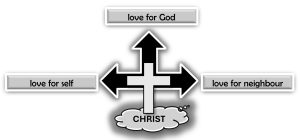
Founded on Christ, one can love God “in spirit and in truth” (John 4:23). Christ is also the sure foundation for true love for self and love for others. The cross is the structure for true love: to God, to self, and to others.
 Personal and societal crisis from an impaired cross
If love for God on the vertical axis of the cross-structure should be broken off, what remains will not be a true cross. If the arm of love for self or love for neighbour on the horizontal level is also damaged, the cross becomes imbalanced, and could crash in suicide or other forms of self-harm or harm to others. One who does not fear God can kill their neighbour. One who cannot forgive themselves can be depressed to the point of suicide. The same lovelessness for oneself can cause great harm to others. The balanced life is that of the wholesome cross.
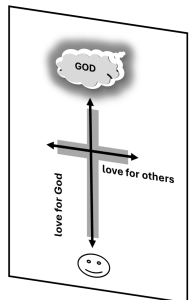
The Ten Commandments have the same ‘cross structure’: the first four commandments (on the vertical axis): have no other God, make no idols, reverence God’s name, honour His Sabbath, are God-ward, connecting humans and God; the last six (on the horizontal axis): honour parents, don’t kill, don’t steal, etc. are people-ward, connecting humans to one another (Exodus 20:1-17). In other words, it takes a relationship with God (on the vertical post) to sustain a virile (horizontal) relationship with others in the same way as the horizontal bar in the cross is borne up by the vertical pole. Without the vertical post on which to mount it, there could be no horizontal bar up; that bar would be down on the floor, and the standing pole could not be called a cross.
When horizontal equanimity with neighbours is not borne by supreme love for God, the effort terminates in the philanthropic waste that Prophet Isaiah describes as “filthy rags” (Isaiah 64:6), and when vertical religion is not balanced by horizontal care and respect for others, it becomes an idle-idol pole, not a cross. They cannot truly relate with others who have an impaired relationship with God; they cannot truly find themselves or find others who have not first found God. Take out the vertical pillar of love for God, and what is left is not a cross but an empty solitary bar tumbling down. Also, take out the horizontal bar, and what you have is a meaningless solitary pole. True spirituality is both towards God and towards other humans (James 1:27; Matthew 25:31-46; Luke 10:30-37; 18:10-14). No aspect is spiritual enough without the other.
Peter Beyond the Roosters
Anyone who loves others enough to forgive them should also be able to forgive themselves for a past that cannot be undone. Judas Iscariot went off to commit suicide out of depression after betraying his Master (Matthew 27:3-5). Peter was similarly guilty of denying the same Master as many as three times in a single night, but he promptly settled it in tears of repentance, and went on to appear on the global stage of Pentecost in such an impactful fashion as greatly diminished his shameful denials as recent as just about two weeks before (Matthew 26:69-75; Acts 2:1-14).
And Peter remembered the word of Jesus, which said unto him, Before the cock crow, thou shalt deny me thrice. And he went out, and wept bitterly (Matthew 26:75).
13 And when they were come in, they went up into an upper room, where abode both Peter, and James, and John…
15 And in those days Peter stood up in the midst of the disciples, and said… (Acts 1:13-15).
Notice the sequence of verbs and adjectives in Peter’s story: after crashing ‘down’ in his denial of the Master, he “went OUT” – to the outside place of bitter tears; then returned with the rest of the team which he later re-joined; assisted by that group-spirit and fellowship of kindred souls, “they come IN” – he might not have been able make it ‘in’ and ‘up’ alone so soon (Galatians 6:1); then there is a climbing upwards as (not he alone but) “THEY went UP” a significantly “UPPER room.” Even there he would not sit in despondent self-immolation but “STOOD up” and thereafter also “said” something – raising his VOICE too. He could no more be silenced by the malicious roosters that daily re-enacted his recent shame. He had found his voice back among the brethren.
Whereas in Matthew 26:75 we read of a tearful, down-cast Peter out-side, in Act 2 we find him back inside (the upper room) and back on his feet; we find him standing UP in an upper room despite his still recent shame; we find him standing before the same teammates who had witnessed his recent blatant falls: “But Peter, standing up WITH THE ELEVEN, lifted up his voice, and said…” (Acts 2:14). No ugly past with its shrill unpleasant daily cockcrows could put him down among ELEVEN standing men; no meticulously repeated early morning broadcasts (or cock-casts) recalling his past shame could kill his determined future; no ugly noises and voices from the past could silence his strong voice that the future was waiting to hear from the global podium of Pentecost; no mocking early morning cock-casts could cast him anymore from the Master’s sober presence into that ‘outside’ isolation of night and suicidal depression. His voice could not be silenced by a past he had confessed, a past about which God had forgiven him and he had forgiven himself. “Peter stood up… and said…” You too, rise out of depression, stand up, and may your voice be heard again, unsilenced by merciless reminders – the early morning roosters that could not kill Peter’s resolve.
If you should mind people so much as to kill yourself because of their views, you still could not have pleased them in the end; you would have died in vain and merely declared your place vacant (as Judas did). When the world hereafter gathers on Pentecost Day, may you not have missed the podium that Heaven has arranged for your international broadcast louder than the malicious early morning roosters have daily announced. May it not be said of you because you could not forgive yourself: VACANCY: “And his bishoprick let another take” (Acts 1:20). Peter fell, yes; but he soon was up again; and his voice was “up,” too.
Peter, depressed by his fall, “went out”; he took himself out of the team, too embarrassed to stand with other ‘cleaner’ folks (Matthew 26:75). But he washed it off that same night in penitent tears, got forgiveness from God, gave himself forgiveness, and “continued” on his way from where his walk had been interrupted. By the time we encounter him further down in the narrative, he was inside again with the team, back on his feet, his voice unsilenced by the accusations of the past with their cockcrow reminders of a shame he no more bore. You cannot stop some cockcrows, but you can decide how you respond to them. If they should stop you, it would not be because of what they announced but because of what you allowed. The roosters will always call, but choose what you hear: the past or your future. Back to the scriptures:
13 And when they were come IN, they went UP into an UPPER room, where abode both Peter, and James, and John…
14 These ALL CONTINUED…
15 And in those days Peter stood UP in the midst of the disciples, and said… (Acts 1:13-15).
He had been down, he was back on his feet; he had been out, he was back inside; he had been silenced by the accusing daily cockcrow, now his voice was up again. It took days to recover, but he recovered “in those days.” He had a message that the world should hear, and he could not be silenced for long; he could not be silenced forever; he could not be stopped. He joined the moving train, and with them “continued” from where he had been paused by a fall. Pentecost celebrated his bold comeback with global fireworks. The Lord had forgiven him, and he had forgiven himself, too. You, too, go join your train again.
Your Past is not as Big as Your Future
Increasingly, studies have shown that self-forgiveness alleviates depression or the effects of it, and reduces suicidality (Jung, et al; Worthington EL. Jr. et al). Judas could not forgive himself, so he sentenced himself to death and personally carried out that sentence on himself. David committed adultery with his absent diplomat’s wife, went ahead to kill that man and married the woman, yet, unlike Judas, he received forgiveness from God, forgave himself, and ‘continued’ on the throne to become Israel’s greatest king.

If God could make a queen mother out of Rahab the notorious regional prostitute of Jericho (Joshua 2:1; Mathew 1:5-6); if God could make a national deliverer out of Moses the murderer and fugitive (Exodus 3:1-6); if God could make a mighty preacher out of Saul the killer and persecutor of His people; if David could go past his adultery and murder to become the beloved of God; if God could stand a woman who lied in His very face, and still make that woman a mother of nations (Genesis 18:15; 21;2-3; 17:15-16), He can still bring beauty out of badness, and treasures out of trash. He is the Great Potter, who said lovingly to failing Israel that even if the clay be spoilt, He could re-design it into another object of no less beauty; that even if judgment had been threatened and there was repentance, He is obligated to show mercy (Jeremiah 18:1-10; Jonah 3:10).
If God can forgive so much, you can forgive yourself also. It is a gift only you can give yourself. Call your name, tell yourself, “I forgive you.” The past is past. Move into your better future. The past shall have no more hold over you, in Jesus name. “Sin shall not have dominion over you” (Romans 6:14). Amen.
I recently watched a Christian woman announce her programme on TV. Boldly, she told of her past: she had been a trafficker, she had dealt in drugs, she had had five abortions, but she had received forgiveness from God and had long ago forgiven herself. She was using the same shame of the past as a platform to help others who are where she used to be. She was speaking to the world from America, thousands of miles away from me. Her past had not silenced her; it had not stolen her future. It actually gave her a platform – or she dared to make a platform out of it, from which the world could hear her melody more loudly than before.
Your past is not as big as your future. March on! Pentecost awaits you on a global stage. March on! You shall not be terminated premature, like Judas. Forgive yourself; say it loud enough to yourself. Post-denial; post-disaster, post-confession: Peter stood up. Nothing could put him down anymore. And he also “lifted up his voice.” He could not be silenced by a shame he could not reverse. Dare to raise your voice. The world is waiting to hear you. It shall not read a disgraceful obituary: “And his bishoprick let another take.” Stand up. Go back in. Speak up. It’s Pentecost Day!


WHAT TO EXPECT AT THESE RETREATS
The Preacher retreats are usually a special gathering for believers seeking spiritual renewal and a deeper fellowship with God through passionate prayers, intense study of the Word, and lively worship. Previous participants consistently declare that the spiritual atmosphere at the retreats is the kind of deepness their soul always longed for, somewhere every serious Christian (especially ministers) should be at, something that reminded them of the fire in the early days of their Christian experience. Starting from Friday evening to Sunday morning, each retreat is usually very intense but very memorable three days.
The retreats usually offer refreshing encounters of no regrets. Meeting brothers and sisters from different Christian and social backgrounds and relating freely and refreshingly as if you had known yourselves all your life time, is another takeaway that many recall. The retreats are guided by the spiritual principle of cooperate ministrations, giving everyone a room to bless everyone else with their unique spiritual gifts and talents, as one big family.
As part of the personal preparations for the retreats, intending participants are usually encouraged to study a given book of the Bible while also observing a weeklong daily fast from the Monday of the retreat week. Participants break the daily fasts with a dinner, and on Sunday morning, there is breakfast before departure, after a brief service concluded with a memorable Holy Communion from which there have usually come testimonies of remarkable healings.
See you at the next retreat …
For respective retreat details, see registration and contact information on the fliers.

GET THESE BOOKS …
One year ago, in March 2025, we posted the last in the series from the book on Forgiveness, thereafter commencing the serialisation of the book, One Woman, Five Husbands: Christian Marriage, Divorce and Remarriage and other messages that followed, prophetically addressing the seasons. Copies of that classic book on Christian marriage and divorce have been out since September 2025. We are urged to return and resume the series on Forgiveness from where we paused a year ago.
For copies of the book Forgiveness (and others not yet out of print), kindly reach us through the contact details provided, or visit the online shops through the links supplied below for the electronic editions of the books so listed – at Amazon and Selar books.
- https://selar.co/m/kontein-trinya1?search=forgiveness – Forgiveness
- https://a.co/d/01BtigEN – One Woman, Five Husbands: Christian Marriage, Divorce and Remarriage
- https://selar.co/903394 – Balaam
- https://selar.co/1g4486 – Stray Bullets
- https://selar.co/443i94 – Mystic Markets
- https://selar.co/q4454b – Beyond Holiness


Oh wow!
This has really blessed me.
Thank you sir.
The LORD will continually enrich you with deep revelations in JESUS mighty name.
Hmmm….. This is profound! If God can….then so can I.
Thanks Dad, for this insightful teaching. 🙏🏽