
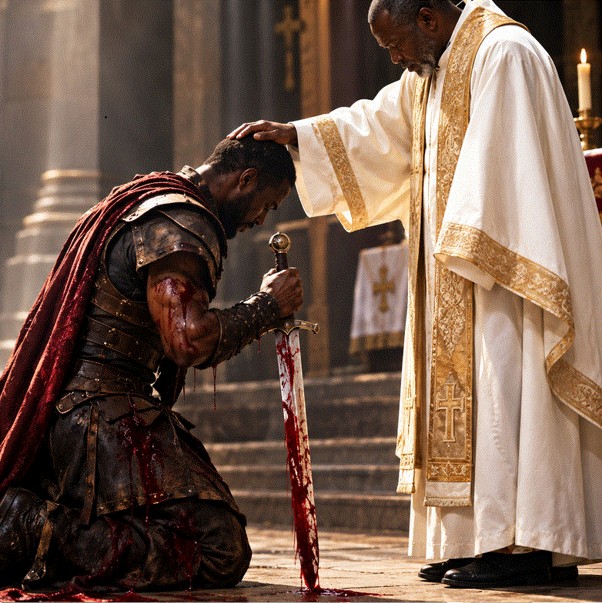
BLESSINGS FOR A SLAUGHTER?
1. Does Some Blood Draw a Blessing?
I have a story to tell, but first, should he be blessed who slaughters another – in war? Does some blood draw a blessing, rather than a curse? Can one confront kings and triumph over them – over their kingdoms? Now, my story … Once upon an ancient time, a godly man’s nephew got abducted by an alliance of terrorist kings. The godly uncle was forced into a rescue war in which he prevailed over the many enemies, and the record says, “For this Melchisedec, king of Salem, priest of the most high God, who met Abraham returning from the slaughter of the kings, and blessed him” (Hebrews 7:1). That godly man was Abraham. Now my many questions …
A priest of God meets a man covered in blood, returning from conquering his enemies, and blesses him. Does God endorse killing, not to talk of a slaughter? Is he a proper priest of God who thus sides with slaughter, and even receives a commission from the booties of that bloody mission (v.2)? If it only said that Abraham “killed,” that might have been less worrisome, but a “slaughter”? What does slaughter even mean? Let’s check the dictionary …
According to my Microsoft Encarta (2009) dictionary, slaughter means to “kill people brutally: to kill a person or large numbers of people brutally.” In the context of the story before us, the casualties couldn’t have been just “a person,” but “large numbers of people,” killed “brutally” … then a priest of God blesses the killer for not shying away from that provocation but confronting it “brutally” and returning triumphantly, drenched in their blood? Others die and one is blessed? Should we ever dance over the graves of our slain? And this is New Testament report?
2. The Priest that Blessed a Slaughterer
Not only is the blesser a “priest of the most high God,” but he is also king of a city called Salem, and King of Salem technically means “King of Peace.” Shouldn’t such a ruler have known better than siding with blood against other rulers? Didn’t he act contrary to his title of peace by apparently siding with blood? Didn’t he care that some might judge that he was bribed and blinded by the bloody booties from the slaughter? Should a king of peace receive gifts from the tokens of a bloody war?
Commonly speaking, two things about this blesser should have refrained him from that act: first, he was a priest of the Most High, and second, he was the King of Peace. Does peace make war? Should priests of God side with killers? Kings die, and a revered priest blesses their gruesome slaughterer? Could we today have accepted such an ‘accomplice’ as a true priest of God? And, can a no-king be so stronger than many killer-kings, because God is on his side? Puzzles …
3. The Puzzle of an Immaculate Killer
The gruesome story of Abraham and his Pastor carries the familiar echoes of another puzzling New Testament verse, an apocalyptic verse – Revelation 19:13: “And he was clothed with a vesture dipped in blood: and his name is called The Word of God.” How could this Commander of Heaven’s Armies still qualify to be called “The Word of God” with His immaculate vesture drenched in the blood of enemies? Yet the Scripture says to “Love your enemies, do good to them which hate you”? (Luke 6:27). How could a vesture so clearly “dipped in blood” (v.13) still be described as “white and clean” (v.14)? Was the reporter ignoring the evident blood stains from the war? Or are some blood stains fanciful trophies and flowery voices on a warrior’s victorious garment? The illustrious Warrior proudly wears a garment drenched in others’ blood – need lesser folks lose their sleep on Another’s designer combat garment so proudly worn? Am I asking too many questions? Or foolish questions?
4. Paradoxes of War
My further puzzles – or questions – are not yet done, from the narrative of the triumphant Warrior in Revelation 19:11: “in righteousness he doth judge and make war.” Is righteousness consistent with making war or making peace? Dare we judge this just Judge who “doth judge and make war,” who makes war only after judging, and is also called “Faithful and True,” crowned with “many crowns” from previous triumphs (v.11)? Could the unfortunate war have been the outcome of judgment in celestial realms for mercies wasted by the adversaries?
That takes me to additional New Testament paradoxes, or so they seem, for example, Romans 16:20, which says that “the God of peace shall bruise Satan under your feet shortly.” Does peace also bruise? Should it? And then Revelation 5:5-6: can the opposite temperaments of Lion and Lamb be reasonably combined in any one personality, according to those verses? And can a traditionally ‘meek and mild’ Lamb be also wrathful; fiercely wrathful to the point of the imperial universal enemies of that Lamb being so terrified as to desperately seek refuge in rocks from the fiery face of that personality, according to Revelation 6:16? Can a Lamb be ever offended, and provoked? Provoked so fiercely that even feared kings would fear to stand?
If I had been reading Isaiah 9:5, about “uniforms bloodstained by war” (New Living Translation) or Isaiah 66:15-16, about the Lord coming with His sword in fury and fire “like a whirlwind” into a battle after which “the slain of the LORD shall be many” (sounds like a slaughter), I might have excused it as Old Testament. But paradoxes of war in New Testament verses … perplexing.
What can I learn more completely about spiritual warfare from the bloody garments of the One who also gave the earthly commands of love? Where is the true balance between love and war? Can one be loving and yet go to war, brutally? Can one be righteous and yet be bloody in war? What verdict or judgment, preceding such wars, justifies the conqueror’s bloody vestures out of the wars?
The Bible says, “we are not fighting against human beings but against the wicked spiritual forces” (Ephesians 6:12, Good News), true. There are dimensions about spiritual warfare that I am yet to grasp more fully, especially considering my next story: a powerful king arrests a simple preacher, intending to kill him at a specific time. His church members promptly get together and pray earnestly, and the preacher is miraculously released, but the same prayer that saves the preacher also kills the king, or so it seems (Acts 12:1-24).
The chapter opens with the bloody intent of the influential king, it closes with his ignoble public death; it begins with the arrest/release of the lowly preacher, it ends with the destruction of his intended killer and the triumph of his hitherto threatened little congregation. In the middle of the plot, between Arrest/Release of the simple hero at the beginning, and Death for the prominent and pompous villainous antagonist at the end, is the intermediating prayer force of the saints. We are not told what the church prayed, except that an angel of God released their pastor and an angel of God (most likely the same angel, after releasing the pastor) also killed the king – in response to their prayers. So, can some prayers kill? Or do they?
Could it have been a boomerang, or what some describe as “back to sender”? Death had been invoked by the throne and could not return without a sacrifice on its altar prepared. In the unfortunate and irreversible absence of the intended sacrifice, somebody had to be offered all the same in replacement. The plotter had to die the death already set in motion by himself. The killer became the killed. The fervent prayers of a threatened church had suddenly made their pastor too large for the altar of Death in that season.
Was that Divine justice? Is that what it means when God says that because His people are very “precious” in His sight, He could “give” others, even nations, in place of them (Isaiah 43:3-4)? Does that explain Old Testament passages like Proverbs 21:18 that says, “The wicked shall be a ransom for the righteous”? And Proverbs 11:8, which says, “The righteous is delivered out of trouble, and the wicked cometh in his stead”? Or a New Testament verse such as 2 Timothy 1:6, that states rather bluntly: “it is a righteous thing with God to recompense tribulation to them that trouble you”? What is the true colour of the justice of God?
5. The Returns
The record says that Abraham was met while “returning” from the slaughter. In other words, he did not expire in that battle, bloody as it had been. He returned. That reads like another New Testament verse, about Jesus: “And Jesus returned from the wilderness…” First, He is “led by the Spirit into the wilderness.” Does the good Spirit of God lead anyone into a precarious wilderness; of all places, a wilderness? Doesn’t the Good Shepherd lead anymore to green pastures and still waters, according to Psalm 23? But next, He “returned” from there, fuller than before He had been led into that place of temptations; He returned full of “the power of the Spirit” (Luke 4: 1, 14). He had been there with a wild Satan tempting His soul and “wild beasts” threatening His flesh, yet He returned, stronger, fuller … (Mark 1:13). Hmm…
Whom God leads into battle returns stronger than before they went into it. The wilderness is not intended as a devouring place for the saint who goes in there full of the Spirit. The Spirit doesn’t lead anyone into the wilderness to abandon them to the battles there, as if frightened off by the devils and the wild beasts. No. He leads thither to increase strength. Ask those who have walked that path. I have my stories, too.
Back to our original story. Should kings be confronted in war? Will a no-king soon prevail over a wicked alliance of four kings? Watch out. Will he “return” whom God leads there? Is every bloodstain not a stain on the vesture of righteousness? Is it unrighteous to engage in a war in which the enemy dies? Is it still justifiable when the slain are a “large number of people”? Is it ungodly for godly men to go to war, and kill, “large numbers” of enemies, brutally? Would that still be New Testament?
From The Preacher’s diary,
October 8, 2026.

