
UNDERSTANDING OPPOSITE PROPHECIES: DOES GOD CONTRADICT HIMSELF?
Prologue …
Does God contradict Himself? Is it still God when apparent signals from Heaven appear to be at conflict with each other?
This prophetic alarm was first published in 2021 in “The Preacher” series, addressing the danger that lay before the land, and still does; the danger of the wrong ‘prophetic fulfilment’ when a season confronts a people with conflicting possibilities from God. Once in a while, that season comes upon a people, the season of a paradoxical binary prophecy – a prophecy of apparently self-contradictory parts, a valid prophecy from the Lord despite its unusual nature of mutually opposite possibilities.
In the past few months, from the last quarter of last year, one has been moved to announce, on occasions, as a few other voices have also done, that a short window of help has opened to the land, but which will not remain open forever. It should last for a few more months in the present year, but probably not until the end of the year. The implication is that a proper response to God is urgent and imperative in this season, while the kairus window lasts.
Again, one has been impelled to recall and proclaim this message once more, in this season, as if to say, after so long, “And the word of the Lord came unto me a second time, saying …” May it be one old message making fresh sense. Amen.
Welcome to the power of choice and “Understanding Opposite Prophecies.”
May 20, 2026
UNDERSTANDING OPPOSITE PROPHECIES: DOES GOD CONTRADICT HIMSELF?
1. What is God Saying?
A few months ago, the United States of America went through what has been adjudged one of its most intense presidential elections, between President Donald J. Trump and Joe Biden. There were prophecies on opposite sides, all claiming to have been the voice of God. In the end, when Biden got sworn in, some of the prophets of the opposite part were compelled to offer a public apology in the ostensible belief that they had given a false prophecy. Did they indeed give a false prophecy?
At the moment in Nigeria, there are also prophecies of an opposite nature, one category threatening irredeemable doom for the veritable abominations of the nation, and the other predicting the expiration of the present tribulations and the ushering in of a great revival. Each category has credible prophets, so the people are sincerely confused about which of the opposite prophecies to believe. Are we about to enter into a dispensation of life or into an inevitable season of doom?
2. Prophetic Parts
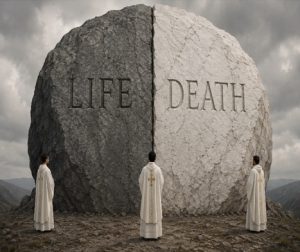
We may find an answer to this riddle in Deuteronomy 30:19, where Prophet Moses revealed that, at that moment in the history of Israel, God had placed the opposite options of “Life” and “Death” before the nation. However, the proclaimer was not going to leave his people in a dilemma, unsure of what to choose. Consequently, he proceeded to urge them to make a right choice between the two opposite options, a choice for Life: “THEREFORE choose life, that both thou and thy seed may live.”
There was an open cheque from God, with the possibility either of “Life” or “Death” being fulfilled. Each of the options was no less ‘from God’ despite being apparently ‘contradictory’ to the other. Each possibility awaited human ‘endorsement,’ which would result in the respective ‘divine fulfilment.’
According to Apostle Paul, every prophet knows only a “part” of the mind of God, his mighty prophecies being merely a large or small “part” in a much bigger prophetic ‘whole’ (1 Corinthians 13:9, 12). That makes it imperative for the humble prophet to always seek what more God could be saying or has said through other vessels apart from himself (2 Chronicles 36:21). Prophet Daniel, for instance, had an impressive ‘part’ of the prophecy about Isarel in diaspora, but the fulness or wholeness of that prophecy, which subsequently led him into his millennial intercession for his people, came only from deliberately seeking and connecting to the ‘part’ that came from an earlier prophet, Jeremiah (Daniel 9:2). Sadly, sometimes, pride, or the sister crisis of naivety, or the unfortunate combination of both, makes a prophet to consider himself so mighty that he would not receive the ‘part’ from other vessels. Persuaded that his ‘part’ is the whole, the totality of all that there is to know, he limits his vision, which makes his alert less wholesome to his hearers.
Prophecy is like a montage or a jigsaw puzzle. It usually takes putting together the ‘parts’ (some ‘parts’ coming from other sources) to get a more holistic view than any of the individual ‘parts’ would offer, no matter how large and magnificent that ‘part’ might seem (1 Corinthians 14:27-31). Even in the Bible, no single prophet showed all that needed to be seen about the birth of Christ or about the end times. Some prophets spoke of His virgin birth, others of His messianic mission, others still of His death and eternal throne. Every Bible student learns to put the ‘parts’ together to get a better view than any single prophet provides, no matter how great the prophet. Old and New, no single testament makes a complete Bible.
Like artists drawing an object from different perspectives, each true prophet usually reports the mind of God based on his relation or position to that Mind of God. For example, while Prophet Hosea projected the mercies and mighty love of God to His wayward people, announcing that the Lord “will have mercy upon the house of Judah” (Hosea 1:7), Prophet Amos, although a contemporary of Hosea, fiercely warned, on the opposite, that “The LORD will roar” and “send a fire,” and “will not turn away the punishment thereof” (Amos 1:2-4).
Hosea could never have been an Elijah, calling down fire upon his challengers; and Elijah could never have been a Hosea, offering rose flowers to recalcitrant Jezebels. Opposite though their prophecies seemed, each was broadcasting from heaven, from their relative positions to the Mind of God. In the Deuteronomy 30:19 case, Moses seemed to have been standing in a more advantaged position than most, from where he could see the opposite options of “Life” and “Death” being offered to his people, for which he urged them “therefore” to make the right choice – the choice for “Life.”
3. Prophetic Addendums
There were two parts to the prophecy of Moses. One part was the voice of God, which warned, “I have set before you life and death, blessing and cursing.” The other part was the voice or counsel of the messenger, which pleaded, “Therefore choose life.” The prophet’s ‘addendum’ was not in itself The Prophecy. It was only the prophet’s ‘remarks.’ The essential prophecy was the opposite options of Life and Death, of Blessing and Cursing, that confronted the people in that season. The ‘addendum’ of the announcer was the “Therefore” counsel that he gave, urging them on which of the options to choose.
Depending on how the ‘addendum’ is phrased, somebody could have taken Moses’ declaration to mean that he was ‘prophesying’ that, even though Death was imminent, the people were surely going to vote for Life, or that Life was going to ‘win’ the popular votes. If that didn’t happen, such naïve ears were bound to have judged Moses as a false prophet.
Whereas Moses, in the present scenario, was privileged to have been standing where he could see the two options, either of which could become the ‘outcome from God’ in the contest between the opposite ‘candidates’ of Life and Death, another lesser prophet, standing at a different angle to the same matter, could have been seeing only one of the two options. Such a prophet might say, for example, “I see Death from the Lord coming upon the land.” He will be as correct as another prophet standing at the other side of the options, who says, “I see Life coming from God upon the land.” This ‘positive’ prophet might proceed to make an intellectual ‘addendum’ to his vision, and declare, “God is offering us Life, ‘therefore’ none should be afraid. Nobody will die.” If eventually that does not become the case, and there is Death instead of Life, the problem may not have been in the “Part A” of the declaration, which was the word from God; it may have been in the “Part B,” which was his inept ‘addendum’ to the word of God that he had received and declared. The ‘failure’ of his prophecy would have come not from the falseness of the prophecy but in how the frail Man of God had handled the sure Word of God; it could have come from the unskilled wordings of his ‘addendum,’ or it could have come even from the prophetic ineptness of the ears that heard him and the lips that consequently interpreted him inadequately.
Not always is the prophetic addendum maturely introduced with a clear “therefore,” as in the case of Moses. That is where problems sometimes arise for gullible ears, as they are unable to distinguish between ‘the Word of God’ and ‘the clause of the messenger.’ Also, not all prophets are mature or even sincere enough, like Paul, to distinguish their addendums from the word of the Lord, by clearly stating, “This is me, not the Lord,” or “This is the Lord, not me” (1 Corinthians 7:6, 10, 12).
When situations like that arise, and ‘opposite prophecies’ appear to be emanating from the throne of God, it is not God speaking from ‘both sides of the mouth’; it is humans reporting the ‘part’ of the prophetic ‘whole’ that each of them can see, or even the ‘part’ that the Almighty has permitted to be unveiled for that time and season (Habakkuk 2:3). Confusions from ‘opposite prophecies’ could also arise from the inability to analyse prophetic parts or comprehend the prophetic whole.
Either of the two options of Life and Death could be fulfilled without the opposite predictor being a false or wrong prophet. Both “Death” and “Life” would be valid messages from God, and either of them could be a valid ‘fulfilment,’ yet whichever of the options gets fulfilled will have depended not on God or the prophet of God but usually on the choice of the people. Note: the people, not a person, not the prophet. Strangely, almighty though God is, He respects the corporate choices of feeble mortals in matters concerning themselves, especially in such seasons of opposite possibilities (1 Samuel 8:7-22; Matthew 18:19; Genesis 11:6). Hear, O land … life and death, blessing and cursing …
4. Making Choices
There are passive and active choices. A voice is a choice; so is silence. When God warned Eli that trouble was coming to his household for the sins of his children, the Associate Priests, he could have gathered everyone and repented before God, but he did nothing (1 Samuel 2:27-29; 3;18). That was a choice. When David was confronted with his adultery and murder, he promptly cried out to God (2 Samuel 12:13). That, too, was a choice. One was a passive choice; the other, an active choice.
When God warns that trouble is coming, but the people prefer to ignore the warning, it can be a vote for Death. It is a passive choice. If they should say, “We do not believe such ‘negative’ prophets and their ‘prophecies of doom.’ No harm shall come to us. We shall continue in our ways,” that is an active choice. If they should gather themselves to penitently seek the face of God, like Nineveh, it is also an active choice, but an active positive choice, whereas the other would have been an active negative choice.
Choices are not always active; sometimes they are passive, but they are choices all the same. Some choices might be negatively active, and others positively active. In other words, whereas passive choices might have their downturn, active choices could also be terrible, if they are not active positive choices. The land has suffered traumas from all kinds of wrong choices.
Sometimes we actually choose, by sheepish ‘political correctness,’ to not choose between radical options. In other words, when we choose not to choose, because we wish to be politically correct, it is still a choice, and God has always respected the choices that people make – from the Garden of Eden, through Samuel and Saul, to Nigeria and America, and now, you.
5. The Jonah Complex
Jonah predicted that God was going to destroy the city and people of Nineveh in forty days. He was very persuaded that it would be so. He never knew that he had seen merely one ‘part’ of the prophetic ‘whole’ on that matter. The other ‘part’ was that, if the people should receive the warning of the prophet and repent, the imminent Death was going to be promptly averted and replaced with Life. Jonah took a fight with God when things did not turn out according to the ‘part’ that he had predicted. If Jonah had been an American, he might have been mocked and cajoled by the press and the social media, until he ‘apologised’ and ‘confessed’ to being a false prophet (Jonah 1-4).
Unfortunately, about one hundred years after Jonah, when all his mockers may have died, the prediction of disaster still came upon Nineveh. There was no Jonah then to warn them, and no king as in the past to compel them to fast and pray in penitence before the angered God (Nahum 1-3; Zephaniah 2:13). Today, what is left of that famous ancient city is a set of pitiful mounds along the banks of the Tigris River in Iraq. Nineveh lies destroyed as Jonah had warned, but not in “forty days” according to his vehement prophetic ‘part.’ Now, supposing the apologizing American prophets are right after now? Supposing they only missed the time, but not the matter, in their ‘addendum’? Supposing …
6. Wrong or False Prophets?
Even when it might not be a case of opposite options, as with Jonah in Nineveh and Moses with the Israelites, sometimes a prophet errs by mistaking his mind for that of God. The great Prophet Samuel got to that place when God sent him to anoint one of the sons of Jesse as king of Israel (1 Samuel 16:6-13). Repeatedly, Samuel kept being distracted by his physical eyes, which were at odds with his spiritual ears. His prophetic ears kept hearing something different from what his physical eyes had been proposing. The prophet was wrong, but he was not false. In other words, there is a difference between wrong prophecy and false prophecy.
Wrong prophecy, or a wrong prophet, is one who makes a sincere mistake, but is a true servant of God, like Samuel. A false prophet, on the other hand, is a messenger of Satan pretending to be an angel of light. He is a deceiver or a “deceitful worker,” who ‘transforms’ himself into what he is not, carrying the title of an Apostle of Christ when he is actually the apostle of Satan (2 Corinthians 11:13-15). Even if such a ‘prophet’ should make a prediction that comes to pass, he is no prophet of God. Even if his prophecies were ‘accurate,’ he still remains a false prophet, according to Deuteronomy 13:1-5, just as the wrong prophet remains a prophet of God despite his wrong ‘addendums’ to the veritable prophetic ‘part’ entrusted to him.
Apart from false and wrong prophets, there are also fake prophets, who are inspired neither by God nor Satan, but are charlatans tricking the gullible; con men operating from the soul rather than from the spirit realm. The true prophet of God is constituted by much more than miracles and the fulfilment of predictions. He is the voice of God. John the Baptist was the greatest prophet that ever was, until his days, yet “John did NO MIRACLE” (John 10:41; Luke 7:28). If a true prophet were to be defined strictly by his miracles, John would have been off the list – the list of men.
7. A Prayer
Open thou mine eyes, O Lord, that I may behold wondrous things out of thy law (Psalm 119:18). Amen. In this season of opposite options from You, O Lord, we choose You; we choose Life and Blessings, that it may be well with us, with our land, and with our children, in Jesus name. Amen.
This is as He ‘wakened my ears to hear’ early this morning, and I was graciously not so rebelliously ‘tired’ as not to have taken notes (Isaiah 50:5).
 From The Preacher’s diary,
April 12, 2021.


This is very revealing and insightful. I mean, Jonah saw just a part and became obsessed with the part. This applies today. That pride needs to be dealt with. Also, the greatest prophet, John the Baptist, never performed a miracle. I’m enlightened here!
False, Wrong and Fake Prophets! O Lord open my eyes and ears to be spiritually discerning, I pray.